
CLICK HERE FOR 7th DISTRICT CONSTITUTION
CLICK HERE FOR STATE PARTY CONSTITUTION
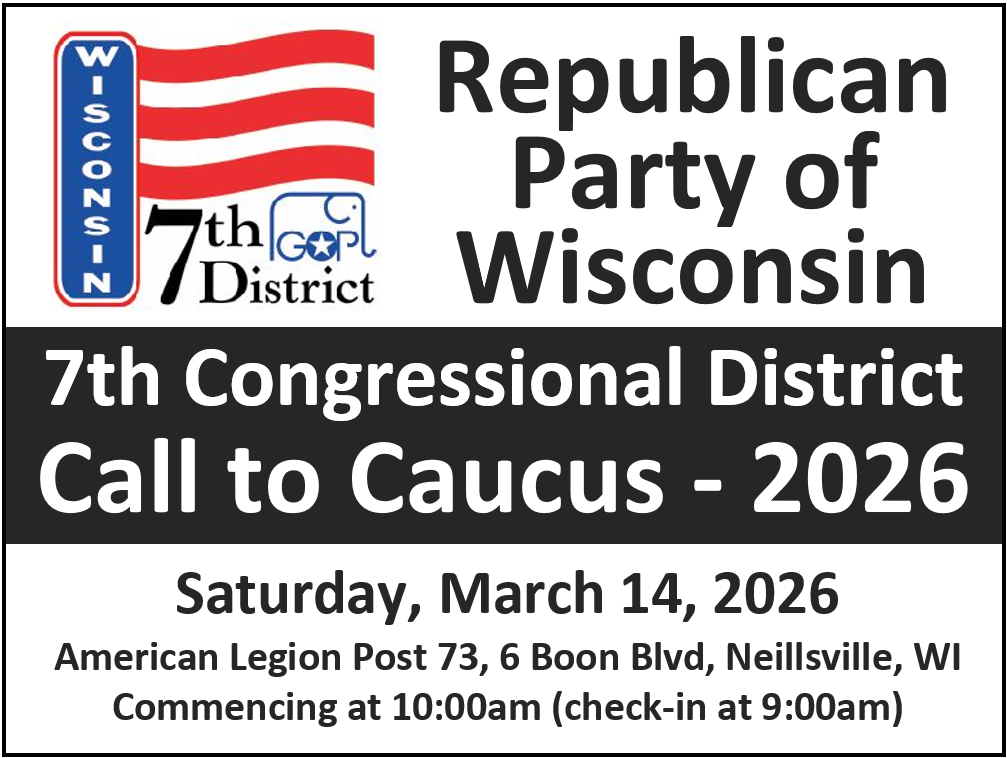
Location and Time:
- Saturday, March 14th, 2026
- 10:00 AM - Call to Order
- 9:00 AM - Check-in
-
American Legion Post 73
6 Boon Blvd, Neillsville, WI
Scroll down for Caucus Content including Agenda, Rules, Proposed Resolutions and Party Constitution
IMPORTANT: To be credentialed and participate as a voting member at the District Caucus (and State Convention), you must be an eligible Voting Member in Good Standing of a County Party in the 7th Congressional District, and must be elected as a Delegate at the annual Caucus in the County in which you reside.
ORDER OF BUSINESS:
- Call to Order
- Invocation / Prayer
- Pledge of Allegiance
- Appointments
- Roll Call
- Approval of Agenda
- Approval of Minutes
- Adoption of Caucus Rules
- Reports of Officers
- Special Guest and Speakers
- Presentation of Awards
- Break for Lunch
- Consideration of Congressional Candidate Endorsement
- Election of State Convention Committee Members
- Approval of Proposed Resolutions
- Announcements
- Adjournment
CD-7 Officers:
- Matthew Rust - Chairman (St. Croix)
- Landis Haldorf - Vice Chair (Lincoln)
- Rose LaBarbera - Secretary (Clark)
- Dylan Anderson - Treasurer (Marathon)
- Maggie Cronin - Finance Chair (Marathon)
Special Guests and Speakers:
- Tom Tiffany - US Congressman, Governor Candidate
- Maria Lazar - Wisconsin Supreme Court Candidate
- Eric Toney - Attorney General Candidate
- Will Martin - Lieutenant Governor Candidate
- Nick Polce - Lieutenant Governor Candidate
- David Varnam - Lieutenant Governor Candidate
- Brayden Meyer - Secretary of State Candidate
- Nate Pollnow - Secretary of State Candidate
- John Leiber - State Treasurer Candidate
- Michael Alfonso - 7th District Congressional Candidate
- Niina Baum - 7th District Congressional Candidate
- Jessi Ebben - 7th District Congressional Candidate
- Kevin Hermening - 7th District Congressional Candidate
- Paul Wassgren - 7th District Congressional Candidate
- Brian Schimming - Chairman, Republican Party of Wisconsin
- Speakers Subject to change.
7th District Counties and Delegate Allotments
- Ashland-18
- Barron-68
- Bayfield-20
- Burnett-29
- Chippewa-49 (partial)
- Clark-43
- Douglas-48
- Florence-10
- Forest-15
- Iron-11
- Jackson-4 (partial)
- Juneau-12 (partial)
- Langlade-32
- Lincoln-44
- Marathon-186
- Monroe-9 (partial)
- Oneida-59
- Polk-74
- Price-24
- Rusk-24
- Sawyer-27
- St. Croix-143
- Taylor-34
- Vilas-40
- Washburn-29
- Wood-43 (partial)
7th District Caucus Rules Committee Report - 2026
Rule 1: Voting Procedures
A. On all questions coming before this Caucus, only when a roll call vote is approved, the delegates and alternates present from any county are authorized to cast the entire vote of the delegation. Vote fractions, if any, shall be carried to two decimal places. Unless otherwise specified by the constitution, all other votes will be by voice vote or by counting of hands if voice vote is indeterminate.
B. When a demand is made that the vote on any question be made by roll call, it shall be seconded by at least one county. Such seconding votes shall be made by a majority of that county’s delegates present.
C. When such a demand is made, the Chairman shall declare, if necessary, a five-minute recess for the purpose of securing seconds.
D. Roll Call/Ballot Vote: A roll call or an endorsement ballot vote is a tally of delegate votes that is determined as follows: Each delegate of a county shall vote a proportion of the county’s total delegates allowed in the ratio of the total delegates allowed the county by the Republican Party of Wisconsin divided by the number of the county’s delegates present at the time of the vote. Example: County A is allowed 10 delegates and 5 delegates are present. Each vote of a delegate of County A counts as two delegate votes.
E. In Instances roll call votes are taken during a Caucus held telephonically because of National and/or State emergency proclamations that prohibit mass gatherings, the Caucus Secretary shall conduct the roll call of individuals credentialed to participate in the Caucus alphabetically by county. Following the roll call, the appropriate weighting factor shall be applied to the number of participants from each county according to that county’s voting strength. Following the calculation of the weighted voting by county, the Caucus Secretary shall announce the results.
Rule 2: Suspension of the Rules
A. A motion to suspend the rules shall be in order only when made by a delegate representing the majority of the moving county and seconded by a majority of delegates from at least two (2) other counties.
B. Upon a proper motion for suspension of the rules, the Chairman shall declare, if necessary, a five-minute recess for the purpose of securing seconds.
C. After a motion to suspend has been placed before the Caucus, it shall be adopted, if approved, by an 80% (4/5) vote of the votes cast by roll call.
Rule 3: Addressing the Caucus
A. Permission to address the caucus shall be obtained from the County Chairman or designated leader, who shall gain recognition from the Presiding Caucus Chairman. If the County Chairman or designated leader is absent, any individual delegate of the County Party may gain recognition from the Presiding Chairman. The county chair should identify whether the member intends to speak “for” or “against” the motion.
B. No delegate shall speak more than twice upon the same question, two (2) minutes on the first occasion and one (1) minute on the second, unless by permission of a majority of the Caucus.
C. Delegates on one side of an issue shall speak for no more than ten (10) minutes unless by permission of a two-third (2/3) majority of the Caucus.
D. In those instances that the Caucus is being held telephonically as a result of a National or State proclamation prohibiting mass gatherings, delegates shall seek recognition from the presiding officer.
Rule 4: Resolutions
A. Before the caucus, the District Chairman shall appoint a Resolutions Committee Chairman. The Committee itself shall be comprised of no more than two representatives from each county, not including the chairman. Resolutions to be acted upon by the caucus shall first have been approved by a majority of the County Caucus submitting the resolution and submitted to the Resolutions Committee by a date determined by the District Executive Committee.
B. The Resolutions Committee shall consider each resolution and act as follows:
a. Recommend approval or make no recommendation on resolutions submitted by the counties.
b. Consolidate resolutions on the same subject and recommend that the consolidated resolutions be considered.
c. Make substantive changes to resolutions submitted by counties with a two-thirds (2/3) majority vote of the committee.
d. Make changes in the spelling and grammar to resolutions as submitted by counties.
C. The Resolutions committee may also draft resolutions on issues of recent current interest by a two thirds (2/3) majority vote of the committee.
D. Subsequent to the meeting of the Resolutions committee, the chairman and secretary of the resolutions committee may make non-substantive changes in grammar, spelling, or punctuation to approved resolutions.
E. The report of the Resolutions Committee shall contain:
a. Those resolutions submitted for approval, including those submitted under Rule 4B (b) and (c) in writing.
b. A list of those resolutions with no recommendation by topic and county of origin.
F. Those resolutions recommended by the Rules Committee shall not require a second. Resolutions with no recommendation from the Resolutions Committee will require a second by the majority of delegates from one county.
G. Resolutions or amendments may be offered for consideration from the floor, but the motion to consider must have the support of a majority of delegates from the presenter’s county and it must be seconded by a majority of delegates from three (3) counties. Amendments must be filed in writing with the Secretary of the Caucus.
H. Those resolutions reported under Rule 4E (b) may be considered as any other resolution from the floor, as specified in Rule 4G and 4I.
I. Resolutions from the floor must be submitted in written form and must be offered at least thirty (30) minutes prior to the convening of the Caucus to the Chairman of the Resolutions Committee with a minimum of forty copies for distribution.
J. Standing Resolutions: Standing resolutions are those that have been approved at the previous District Caucus. The Resolutions Committee will review these resolutions and determine if any of them are no longer relevant. The remaining standing resolutions will be presented to the Caucus delegates as a group for approval and will be voted on as a group for approval. Amendment motions may be made from the floor regarding individual resolutions contained in the standing resolutions. The removed standing resolutions, if any, will be reported to the Caucus delegates for information purposes only. A standing resolution that is amended by the Resolutions Committee will be presented to the caucus delegates individually for approval.
Rule 5: Rules of the Caucus
A. Robert’s Rules of Order, Newly Revised, shall be the rules of this Caucus, so far as they are applicable and not inconsistent with the rules adopted, except that a motion to adjourn shall be debatable.
B. Any person wishing to be a delegate at Caucus who is not on a delegate/alternate list must be verified as a member in good standing by an officer or acting officer of a member county. An acting officer must have written authorization from the County Chairman or Vice Chairman stating that they are acting on behalf of said county.
Rule 6: Persons in Delegate Section
No person(s) except members of the delegation and officers of the Caucus shall be admitted to the section of the hall apportioned to the delegates. No person may be on the floor with the delegates, or speak on behalf of the delegates, on behalf of any congressional candidate seeking the endorsement of the Seventh Congressional District Caucus unless that person is a registered delegate of a local county Republican Party within the Seventh Congressional District. The Chair shall direct the sergeant at arms to enforce this rule and order the removal of any person in violation of it.
Rule 7: Agenda
The order of business shall be printed in the official agenda. The order of business can be altered by consensus of the delegates or by a simple majority vote.
Rule 8: Compliance
To ensure compliance with the Wisconsin State Elections Law and the Republican Party of Wisconsin’s Constitution, the two individuals referred to in 8.17 (8) (a), (b), (c) of the State Election Law who are to be elected to serve on the State Executive Committee shall be the individuals elected as the Chairman and Vice Chairman of the Seventh Congressional District organization.
Rule 9: Election of Officers
A. Before the Caucus in odd numbered years, the Chairman shall appoint a Nominating Committee of not less than five (5) members.
B. The Nominating Committee shall nominate at least one (1) candidate for the following offices: Chairman, Vice-Chairman, Secretary, Treasurer and Finance Chairman.
C. Following the report of the Nominating Committee, elections shall be held in the following order, Chairman, Vice-Chairman, Secretary, Treasurer and Finance Chairman.
D. Prior to voting for each position, nominations from the floor will be entertained.
E. Following the close of nominations, each candidate shall be given five (5) minutes to address the Caucus.
F. Unless otherwise determined by vote of the delegates, voting shall be by roll call of the counties.
G. Officers must be elected by a majority vote. In the event any candidate does not receive a majority, subsequent roll calls will be held until a candidate receives a majority vote. In the event any candidate does not receive a majority after one roll call vote, only the two candidates receiving the greater number of votes will be considered on the second roll call vote.
Rule 10: Election of Delegates and Alternates to the National Convention
A. Three (3) delegates and three (3) alternates to the National Convention shall be elected by the delegates and alternates present at the District Caucus in presidential election years. Prior to the vote, there shall be a Call of the House, and no delegate shall leave the caucus floor nor shall any delegate be admitted to the caucus floor after the Call of the House until the National Convention delegates and alternates are elected. Immediately after the Call of the House, the Secretary shall conduct a roll call of the counties to determine how many delegates are present in each delegation.
B. The District Caucus delegates and alternates present at the Caucus may vote for three (3) different potential National Convention delegates from those submitted by the District Chairman pursuant to Article X, Section 2, Rule 5, Paragraph 1 of the Republican Party of Wisconsin Constitution.
C. Voting shall be by secret ballot. Voting shall be on a printed ballot provided to all properly credentialed delegates and alternates upon their registration at the District Caucus. All Delegates and Alternates present at the District Caucus shall vote for their choice of up to three (3) different delegates to the National Convention. Those candidates for delegate and alternate preferred by the committee of the winner of the Wisconsin Presidential Primary election in the Seventh Congressional District shall be made known to the Caucus.
D. All ballots shall be delivered to the County Chairman or his/her designated representative. The County Chairman or his/her designated representative shall tabulate the valid ballots and present the vote totals to the District Chairman, or to whomever he may designate, to confirm the election results. The District Chairman or designee shall calculate the vote totals, as presented by the County Chairman, by factoring the county credentialed delegates with the allotted county delegates.
E. The top three vote recipients shall be delegates to the National Convention. The next three top vote recipients shall be alternates to the National Convention. In the case of a tie which affects the outcome, there shall be a re-balloting involving only those candidates who are tied. Only one vote per delegate shall be cast in the tie-breaking vote. Ties shall be broken by those with the highest number of votes. The District Chairman shall announce the results of the election following the roll call.
Rule 11: District Candidate Endorsement
A. In the even-numbered years, the Caucus may consider endorsing a congressional candidate. The method shall follow the rules of all other motions.
B. Republican candidate(s) for the office of Congress shall be afforded the opportunity to speak for seven (7) minutes and present materials to the Caucus at a time on the agenda. The order of speaking shall be a name drawn from a hat by the Chairman and is to be witnessed in front of the delegation.
C. Any person seeking the endorsement of the Seventh Congressional District Caucus must be a member in good standing of the local county Republican Party in the county in which that person resides.
D. Voting on a candidate for endorsement for office shall be by secret ballot. Each county will be allowed to cast the number of ballots allowed for their delegate total even if only one delegate is present at the Caucus. The Caucus may decide by a two-thirds (2/3) vote to endorse by a rising vote if there is only one candidate.
E. Votes may be cast only for a person who is legally eligible for election to the office of Representative in Congress and who satisfies the eligibility requirements set forth in the CD7 Rules. Any ballot not containing the name of an eligible candidate shall not be counted. No preprinted ballots shall be permitted. Beginning after the second ballot, the candidate receiving the fewest votes shall be removed from the next succeeding ballot, and the same procedure shall apply after each subsequent ballot. In the event of a tie for the fewest votes, no candidate shall be eliminated, and all tied candidates shall remain on the next ballot.
F. An endorsement may carry with it the commitment of party resources, finances, and volunteers. A county represented at the annual Caucus of the Republican Party of the Seventh Congressional of Wisconsin shall not endorse a candidate other than the one endorsed at large.
G. A call for quorum or adjournment shall be considered out of order and will not be recognized until the endorsement process is complete.
Rule 12: Rule Changes
A. The report of the Rules Committee is subject to a revision by a majority vote of the Caucus.
B. Following the adoption of these rules, any further rule changes shall be presented by the Rules Committee Chairman clearly designated as a change from prior rules, and shall be accompanied by a brief comment as to the purpose and effect of said change and the reason for making it.
C. These rules shall remain in force for any subsequent Caucus until such time as that Caucus adopts its own rules.
Rule 13: Close of Check-In
Check-In of delegates and alternates will close 5 minutes before the time of the Caucus that is announced in the Call to Caucus. At this time the Credentials Committee will prepare the Credentials Report. Delegates or Alternates failing to register prior to the close of registration may not be seated as Caucus delegates. It will be the Credentials Committee’s discretion to seat late registration/check-in delegates.
7th District Caucus Proposed Resolutions - 2026
2026-01 (Barron)
Resolution Requesting Timely Communication from the RPW
WHEREAS, effective governance relies on clear, consistent, and timely communication between the RPW and its county parties; and
WHEREAS, delays or gaps in communication can hinder planning, disrupt operations, and negatively impact on the ability of county parties to serve their membership efficiently; and
WHEREAS, timely dissemination of information—particularly regarding policy changes, funding decisions, regulatory updates, training, and emergency matters—is essential to maintaining transparency, accountability, and party trust; and
WHEREAS, improved communication practices would strengthen coordination, reduce confusion, and support better outcomes for republicans across the State.
NOW, THEREFORE, BE RESOLVED, that the Republican Party of Wisconsin's 7th Congressional District formally requests that the State adopt and maintain communication practices that ensure information is shared promptly, clearly, and consistently with all relevant to all republicans; and
BE IT FURTHER RESOLVED that the State be encouraged to establish defined timelines, communication protocols, and points of contact to facilitate efficient information flow; and
BE IT FINALLY RESOLVED that copies of this resolution be transmitted to the RPW to underscore the importance of timely communication.
2026-02 (Barron)
Resolution Supporting the Audit of Food Stamp Rolls to Prevent Fraud in Wisconsin
WHEREAS, the State of Wisconsin administers the Supplemental Nutrition Assistance Program (SNAP), commonly known as food stamps, to ensure that low‑income individuals and families have access to essential nutrition; and
WHEREAS, the integrity of public assistance programs is essential to maintaining public trust, ensuring taxpayer dollars are used responsibly, and protecting resources for eligible households who rely on these benefits; and
WHEREAS, instances of fraud, waste, or abuse—whether through inaccurate reporting, trafficking of benefits, or misuse of program eligibility—undermine the effectiveness of SNAP and reduce the availability of support for those who genuinely need it; and
WHEREAS, periodic audits and eligibility reviews are recognized tools for improving program accuracy, identifying improper payments, and strengthening administrative oversight; and
WHEREAS, ensuring accountability within public benefit programs aligns with Wisconsin’s commitment to transparency, fiscal responsibility, and the fair distribution of assistance.
NOW, THEREFORE, BE IT RESOLVED, that the Republican Party of Wisconsin's 7th Congressional District supports authorizing regular annual, comprehensive audits of Wisconsin’s SNAP enrollment rolls for the purpose of identifying and preventing fraud, waste, and abuse; and
BE FURTHER RESOLVED, that such audits shall be conducted in a manner that:
- Protects the privacy and dignity of program participants,
- Ensures due process for individuals flagged for review,
- Avoids unnecessary administrative burdens on eligible households, and
- Prioritizes accuracy, fairness, and efficiency.
BE IT FURTHER RESOLVED, that the State of Wisconsin is encouraged to allocate appropriate resources, staffing, and technological tools to support these audits and to strengthen verification processes, inter‑agency data sharing, and fraud prevention measures, that will be made public; and
2026-03 (Chippewa)
Proposed Anti-Sharia Caucus in Congress
WHEREAS, the Muslim Brotherhood is a global political organization that advances the mission of installing Sharia Law throughout the world,
WHEREAS, Sharia Law is a system of laws that is incompatible with the U.S. Bill of Rights of the U.S. Constitution including all of the 1st Amendments protections which are freedom of speech, free exercise of religion, freedom from the government establishment of religion, freedom to assemble, freedom to petition the government for redress; 4th Amendment due process rights, 5th Amendment Equal Protection Rights, 8th Amendment -Freedom from cruel and unusual punishments; 13th and 14th Amendments, etc.
WHEREAS, Sharia Law violates the rights of conscience/religion of all people by forcing a government mandated religion upon people in a Muslim controlled country/state/county/community and enforces blasphemy laws which restrict speech that criticizes Islam/Mohammed/Allah; punishes people through torture and death for violating Sharia; encourages child rape/marriage and subjugates women to the status of chattel which are elements of Sharia Law.
WHEREAS, CAIR the self proclaimed civil rights organization of the Muslim Brotherhood is an unindicted co-conspirator of the Holy Land Foundation trials which convicted members of raising money for Hamas, a terrorist organization in the State of Texas in 2004 and 2005.
NOW, THEREFORE, BE IT RESOLVED, that the members of the Republican Party of Wisconsin's 7th Congressional District together at caucus assembled encourage all Wisconsin Congressional members to join the Anti-Sharia Caucus started by Congressman Chip Roy with the goal of prohibiting Sharia law from being consulted or implemented and utilized in any court in the United States of America and in the State of Wisconsin.
2026-04 (Chippewa)
Proposed Resolution for Congress and for the Wisconsin State Legislature to Designate the Muslim Brotherhood as a Terrorist Organization
WHEREAS, the Muslim Brotherhood is a global political organization that advances the mission of installing Sharia Law throughout the world, and has stated in the Explanatory Memorandum written in 1991 and most recently in a live recording of Niwad Awad, President of CAIR in America, at an ISNA Conference in 2025, that the Muslim Brotherhood intends to take over the United States of America through the legal and political process as they have already done throughout the fallen countries of Europe;
WHEREAS, the CAIR through Niwad Awad encouraged every Mosque in America to set up scholarship funding for Muslim students so that they can, in a few years, have 50,000 lawyers that will become politicians, judges and legislators that will be critical assets in destroying the U.S. Constitution and the Bill of Rights by installing Sharia Law throughout the United States of America, by using our “own miserable hands,” as it was stated in the Explanatory Memo in 1991.
WHEREAS, Sharia Law is a system of laws that is incompatible with the U.S. Bill of Rights of the U.S. Constitution including all of the 1st Amendments protections which are freedom of speech, free exercise of religion, freedom from the government establishment of religion, freedom to assemble, freedom to petition the government for redress; 4th Amendment due process rights, 5th Amendment Equal Protection Rights, 8th Amendment -Freedom from cruel and unusual punishments; 13th and 14th Amendments, etc.
WHEREAS, by installing Sharia Law through the country, this 250-year experiment in self-governance will end and the violation of the rights of conscience/religion of all people will occur as a Muslim Brotherhood controlled government will mandate the religion of Islam on all people and will enforce blasphemy laws which restrict speech that criticizes Islam/Mohammed/Allah. This has already occurred in Britain (once Great). Gay people will be punished through torture and death for violating Sharia. Child rape/marriage will be encouraged, and the rape and subjugation of non-Muslim women will go unpunished as police are ordered to look the other way and arrest the reporters of such crimes, as has already occurred routinely in England and the rest of Europe for at least the past ten years.
WHEREAS, CAIR, the self-proclaimed civil rights organization of the Muslim Brotherhood which is an unindicted co-conspirator of the Holy Land Foundation trials which convicted members of raising money for Hamas, a terrorist organization in the State of Texas in 2004 and 2005, will continue to wage war in our courts until it dominates the judicial system.
NOW, THEREFORE, BE IT RESOLVED, that the members of the Republican Party of Wisconsin's 7th Congressional District together in caucus assembled, encourage all Wisconsin Congressional members and all State legislators in joining together to follow in the footsteps of the States of Texas and Florida in designating the Muslim Brotherhood as a Terrorist Organization along with its members, causing the Department of Justice to open investigations into the treasonous and criminal allegations of its members, and if probable cause is found, to try such terrorists and to imprison, deport or hang such traitors to the United States of America and its Constitution as the Founders of this Nation provided for circumstances.
2026-05 (Marathon)
Protecting Wisconsin Taxpayers, Communities, and Rural Areas from Large-Scale Battery Energy Storage Systems (BESS)
WHEREAS, Wisconsin taxpayers fund public projects, and large-scale Battery Energy Storage Systems, typically using lithium-ion batteries, involve high costs, long-term maintenance, and financial risks that should fall on private developers rather than the public; and
WHEREAS, Wisconsin currently lacks comprehensive statewide regulations specifically governing the siting, fire safety, emergency response planning, setback distances, or operational standards for large-scale BESS facilities, leaving rural communities vulnerable to unregulated risks without uniform protections; and
WHEREAS, large-scale BESS facilities pose severe fire and explosion hazards, including the risk of thermal runaway, which can release highly toxic and flammable gases such as hydrogen fluoride and carbon monoxide; ignite rapidly, burn for days, and reignite unexpectedly, endangering lives, property, and public health; and
WHEREAS, rural fire departments and emergency medical services are already stretched thin and lack the specialized training, equipment, or resources to safely respond to large-scale BESS fires, explosions, or toxic releases, placing entire communities at unacceptable risk; and
WHEREAS, documented incidents nationwide demonstrate that large-scale BESS fires and explosions can result in prolonged emergencies, evacuations, human injury, environmental contamination, economic disruption, and overwhelming demands on local emergency services; and
WHEREAS, large-scale BESS projects can reduce property values, deter future residential, agricultural, or commercial development, strain local infrastructure, and irreversibly alter rural landscapes, diminishing Wisconsin’s aesthetic and cultural character; and
WHEREAS, public trust in regulatory bodies, including but not limited to the Public Service Commission, has declined due to insufficient oversight and a pattern of ignoring safety issues, leaving communities unprotected.
NOW, THEREFORE, BE IT RESOLVED, that Republican Party of Wisconsin's 7th Congressional District urges the Wisconsin Legislature to reject legislation authorizing taxpayer funding, subsidies, or tax credits for large-scale BESS projects; and
NOW, THEREFORE, BE IT FURTHER RESOLVED, that Republican Party of Wisconsin's 7th Congressional District calls on the Legislature and Public Service Commission to protect taxpayers and rural communities, ensure local control over land-use decisions, establish immediate statewide regulations addressing fire, explosion, toxic emission, and emergency response hazards, hold developers and regulatory bodies accountable, mitigate safety and environmental risks, and encourage energy infrastructure that is financially self-supporting without reliance on public funding; and
NOW, THEREFORE, BE IT FURTHER RESOLVED, that copies of this resolution shall be sent to the Governor of Wisconsin, the leadership of the State Senate and Assembly, the Public Service Commission, and the state legislators representing the members of Republican Party of Wisconsin's 7th Congressional District.
2026-06 (Marathon)
Protecting Wisconsin Taxpayers, Farmland, Water, and Rural Communities from Large-Scale Data Centers
WHEREAS, Wisconsin taxpayers fund public projects, and large-scale data centers involve high capital costs, long-term operational demands, and financial risks that should fall on private developers rather than the public; and
WHEREAS, Wisconsin currently lacks comprehensive statewide regulations governing siting, energy allocation, water usage, environmental safeguards, or cost recovery for large-scale data centers, leaving rural communities exposed to unregulated or inconsistently regulated impacts; and
WHEREAS, these facilities consume massive amounts of electricity, potentially doubling utility demand in some regions, creating significant pressure on the power grid and potentially increasing energy costs for residential and commercial ratepayers; and
WHEREAS, data centers tend to use large amounts of water for cooling, as it is often the most cost-effective method, which can strain local water resources and compete with agricultural, household, and environmental needs, with potential risks of contamination; and
WHEREAS, construction of large-scale data centers frequently converts prime farmland and rural acreage into industrial sites, leading to permanent loss of productive agricultural land; and
WHEREAS, these developments can reduce property values due to noise, light, visual impacts, perceived risks, and infrastructure burdens, resulting in lost revenue for residents, towns, and counties; and
WHEREAS, data centers deter future residential, commercial, or alternative agricultural development, and irreversibly alter rural landscapes, diminishing Wisconsin’s aesthetic and cultural character; and
WHEREAS, such projects strain local infrastructure, including roads, bridges, utilities, and emergency services, increasing costs for taxpayers while providing minimal long-term local employment relative to their scale; and
WHEREAS, public trust in regulatory bodies, including but not limited to the Public Service Commission, has declined due to insufficient oversight and patterns of rapid approvals without adequately addressing community concerns.
NOW, THEREFORE, BE IT RESOLVED, that the Republican Party of Wisconsin's 7th Congressional District urges the Wisconsin Legislature to reject legislation authorizing taxpayer funding, subsidies, tax exemptions, or other public incentives for large-scale data centers; and
NOW, THEREFORE, BE IT FURTHER RESOLVED, that the Republican Party of Wisconsin's 7th Congressional District calls on the Legislature and Public Service Commission to protect taxpayers and rural communities, preserve local control over land use and zoning, safeguard farmland and water resources, prevent cost-shifting of energy and infrastructure burdens to residential ratepayers, establish immediate statewide regulations addressing energy demands, water usage, environmental impacts, and developer accountability, mitigate risks to property values, agriculture, wildlife, and quality of life, hold regulatory bodies accountable, and encourage developments that are financially self-supporting without reliance on public funding; and
NOW, THEREFORE, BE IT FURTHER RESOLVED, that copies of this resolution shall be sent to the Governor of Wisconsin, the leadership of the State Senate and Assembly, the Public Service Commission, and the state legislators representing the members of the Republican Party of Wisconsin's 7th Congressional District.
2026-07 (Rusk)
A Resolution Affirming the Principle of Educational Freedom and Supporting School Choice Options for Families
WHEREAS, parents and guardians are the primary stakeholders in a child’s education and should have the ability to choose the educational setting that best meets their child’s needs; and
WHEREAS, a diverse education ecosystem—including public, charter, private, faith-based, home, and hybrid learning options—can foster innovation, accountability, and improved outcomes; and
WHEREAS, school choice policies may expand access to quality educational opportunities, particularly for students in underserved or geographically limited communities; and
WHEREAS, responsible school choice programs can be designed to respect state and local control, protect taxpayer interests, and ensure appropriate academic and financial accountability,
NOW, THEREFORE, BE IT RESOLVED, that the Republican Party of Wisconsin’s 7th Congressional District, at caucus assembled, affirms its support for the principle of educational freedom and parental choice in K-12 education, and
BE IT FURTHER RESOLVED, that such policies should prioritize transparency, student achievement, fiscal responsibility, and equal opportunity, and
BE IT FURTHER RESOLVED, that this Caucus supports policies that expand lawful school choice options, including but not limited to education savings accounts, scholarships, tax credits, charter schools, and open enrollment, consistent with state and federal law; and
BE IT FINALLY RESOLVED, that the Caucus encourages broadening school choice initiatives to ensure they serve students, families, and communities effectively while maintaining accountability and educational quality.
2026-08 (Rusk)
SUPPORT FOR ESTABLISHING MORE RIGOROUS EDUCATIONAL STANDARDS FOR WISCONSIN’S PUBLIC SCHOOLS
WHEREAS, providing a high-quality education for all children is one of our state’s major responsibilities, and
WHEREAS, the vast majority of students in Wisconsin do not achieve the reading and math skills necessary to reach grade level proficiency standards according to the 2024 National Assessment of Educational Progress (NAEP) results, and
WHEREAS, providing a quality education requires setting high standards and adopting rigorous systems of curriculum and instruction to ensure that all children meet or exceed proficiency standards and graduate with the academic skills necessary to be college and career ready, and
WHEREAS, the Wisconsin Department of Public Instruction recently lowered state standards on their statewide assessment system (Forward Exam) to make it appear that more students are successful without the schools making actual improvements in the academic performance of those students, and
WHEREAS, the Wisconsin Department of Public Instruction also recently adopted a state report card system such that 94 percent of Wisconsin’s school districts received a “meets expectations” or “exceeds expectations” grade despite the poor academic skills of the students in those districts, and
WHEREAS, Wisconsin’s state report card system gives an undue advantage to low-income schools and heavily weights factors (such as progress toward graduation) that can be easily influenced or manipulated to make the public believe their schools are doing well despite the poor academic performance of their students,
THEREFORE, BE IT RESOLVED that the Republican Party of Wisconsin’s 7th Congressional District in caucus assembled, requests that the Wisconsin State Legislature require the Department of Public Instruction to change the state report card system to weigh academic performance factors more heavily and raise their statewide assessment system standards on the Forward Exam to be consistent with the more rigorous national proficiency standards.
2026-09 (Rusk)
RESOLUTION REQUIRING PRESENTATION OF VALID PHOTO IDENTIFICATION TO VERIFY UNITED STATES CITIZENSHIP BEFORE VOTING
WHEREAS, the integrity, security, and public confidence in elections are essential to the preservation of a constitutional republic; and
WHEREAS, the right to vote in United States elections is reserved for citizens of the United States, as established by federal and state law; and
WHEREAS, reasonable safeguards help ensure that only eligible voters participate in elections while protecting the rights of lawful voters; and
WHEREAS, the presentation of valid photo identification is a commonly accepted method for verifying identity and eligibility in numerous civic and legal contexts; and
WHEREAS, clear and uniform verification standards promote transparency, consistency, and confidence in the electoral process;
NOW, THEREFORE, BE IT RESOLVED, that the Republican Party of Wisconsin’s 7th Congressional District supports and calls for the enactment of laws and regulations requiring individuals to present a valid government-issued photo identification that verifies United States citizenship before casting a ballot in any election; and
BE IT FURTHER RESOLVED, that acceptable forms of identification should be clearly defined by law, reasonably accessible to eligible voters, and administered in a fair, uniform, and non-discriminatory manner; and
BE IT FURTHER RESOLVED, that provisions should be made to ensure no eligible citizen is unreasonably burdened or disenfranchised, including appropriate alternatives or assistance consistent with constitutional and statutory requirements; and
BE IT FURTHER RESOLVED, that this resolution affirms a commitment to both election integrity and the protection of lawful voting rights; and
BE IT FURTHER RESOLVED, that a copy of this resolution be transmitted to the appropriate legislative and election authorities for consideration and action.
2026-10 (St. Croix)
RESOLUTION OPPOSING SOLAR FACILITIES USING PUBLIC FUNDING ON PRODUCTIVE FARMLAND
- Opposing the Development of Utility-Scale Solar Facilities in the State of Wisconsin
WHEREAS, The State of Wisconsin has a long-standing agricultural heritage, and productive farmland serves as a vital economic, cultural, and food-producing resource; and prime, productive agricultural land is a finite and irreplaceable resource necessary for vitality of rural economies, and the preservation of working farms; and
WHEREAS, Utility-scale solar facilities may require substantial acreage, including land currently used for crop production or livestock operations, and the conversion of usable farmland to industrial-scale solar development may reduce agricultural output and alter the rural character of local communities; and
WHEREAS, Northern latitude states, including Wisconsin, experience seasonal variations in daylight hours, lower winter sun angles, increased cloud cover, and snow accumulation, which may reduce the efficiency and reliability of solar energy production compared to regions closer to the equator, and such geographic and climatic factors require larger land areas to generate comparable levels of electricity, thereby increasing land-use impacts; and
WHEREAS, Local zoning ordinances are designed to reflect the will of the community and to balance agricultural, residential, commercial, and industrial land uses; and the modification of zoning ordinances to accommodate large-scale solar installations may reduce surrounding property values and residents’ quality of life; and
WHEREAS, Public funds should be allocated in a manner that reflects fiscal responsibility and prioritizes essential public services and infrastructure; and the use of taxpayer-funded subsidies, grants, or incentives for solar facilities may impose financial burdens or opportunity costs on residents; and
NOW, THEREFORE, BE IT RESOLVED, That The Republican Party of Wisconsin's 7th Congressional District in Caucus assembled, formally opposes the approval, construction, or expansion of utility-scale solar facilities within Wisconsin that utilize public funding, require non-disclosure actions, changes to existing zoning ordinances, or are sited on productive agricultural land; and
BE IT FURTHER RESOLVED, That the RPSCC supports the preservation of prime farmland for agricultural use and encourages land-use policies that protect working farms and rural communities; and
BE IT FURTHER RESOLVED, That the RPSCC opposes the allocation of local or state taxpayer funds for the development of solar facilities meeting the above criteria; and
BE IT FURTHER RESOLVED, That the RPSCC supports Congressman Tom Tiffany’s Future Agriculture Retention and Management (F.A.R.M.) Act, introduced to protect American Farmland; and
BE IT FINALLY RESOLVED, That copies of this resolution be transmitted to appropriate municipal, county, and state officials, including members of the Wisconsin Legislature and relevant regulatory agencies.
2026-11 (St. Croix)
RESOLUTION IN SUPPORT OF ELECTION INTEGRITY REFORMS
- To Affirm Commitment to Election Integrity and Secure Voting Practices
WHEREAS, the integrity of elections is fundamental to maintaining public trust in our constitutional republic and preserving the consent of the governed; and
WHEREAS, the Republican Party has long supported policies that promote transparency, accountability, and security in the administration of elections; and
WHEREAS, centralized vote tabulation processes (“central counts”) may reduce transparency and diminish public confidence by limiting local oversight and chain-of-custody safeguards; and
WHEREAS, unattended ballot drop boxes may increase the risk of ballot harvesting, chain-of-custody vulnerabilities, and unequal enforcement of election laws; and
WHEREAS, large-scale mail-in voting systems may present increased risks of fraud, coercion, ballot trafficking, administrative error, and delayed election results; and
WHEREAS, accurate and regularly maintained voter registration rolls are essential to ensuring that only eligible citizens vote and that each lawful vote is counted once; and
WHEREAS, federal tools and cooperative verification systems, including the Systematic Alien Verification for Entitlements (SAVE) Program administered by the U.S. Citizenship and Immigration Services, provide mechanisms for verifying lawful citizenship status; and
WHEREAS, supporting the federal SAVE System can assist states in verifying voter eligibility consistent with federal law;
NOW, THEREFORE, BE IT RESOLVED, that the Republican Party of Wisconsin’s 7th Congressional District formally supports legislation and administrative rules to prohibit centralized vote counting (“central counts”) and instead require precinct-based counting with full transparency and bipartisan oversight; and
BE IT FURTHER RESOLVED, that this body supports legislation to prohibit the use of unattended ballot drop boxes; and
BE IT FURTHER RESOLVED, that this body supports legislation to prohibit universal or no-excuse mail-in balloting and to limit absentee voting to clearly defined statutory circumstances with appropriate verification safeguards; and
BE IT FURTHER RESOLVED, that this body supports comprehensive and regular maintenance of voter registration rolls to ensure removal of deceased individuals, non-residents, and ineligible registrants in accordance with state and federal law; and
BE IT FURTHER RESOLVED, that this body supports state participation in and full utilization of the federal SAVE System for the purpose of verifying voter eligibility and citizenship status; and
BE IT FURTHER RESOLVED, that this body supports legal accountability whenever a person does not adhere to election laws; and
BE IT FINALLY RESOLVED, that this resolution be transmitted to our state legislative delegation, and all relevant election authorities for consideration and action.
2026-12 (St. Croix)
RESOLUTION IN SUPPORT OF TITLE IX’S ORIGINAL MEANING OF BIOLOGICAL SEX
- Affirming the Original Intent of Title IX Against Discrimination Based on Biological Sex
WHEREAS, Title IX of the Education Amendments of 1972 was enacted to prohibit discrimination on the basis of sex in education programs and activities receiving federal financial assistance; and
WHEREAS, At the time of its enactment in 1972, the term “sex” was understood in federal law and public usage to refer to biological distinctions between males and females; and
WHEREAS, Title IX has played a significant role in expanding educational and athletic opportunities for women and girls by ensuring equal access, resources, and protections based on biological sex; and
WHEREAS, The preservation of sex-separated spaces and competitive categories, including in athletics, has historically been justified on the basis of biological differences between males and females; and
WHEREAS, Clear and consistent statutory interpretation promotes legal stability, institutional compliance, and public confidence in the rule of law; and
WHEREAS, Changes to statutory meaning are most appropriately made through the legislative process rather than through administrative reinterpretation; and
WHEREAS, Maintaining sex-based protections in education can be viewed as essential to safeguarding fairness in women’s athletics, privacy in sex-separated facilities, and equal opportunities for female students;
NOW, THEREFORE, BE IT RESOLVED, That The Republican Party of Wisconsin's 7th Congressional District in Caucus assembled, affirms its support for interpreting Title IX consistent with its original public meaning, recognizing “sex” as referring to biological sex as understood at the time of enactment in 1972; and
BE IT FURTHER RESOLVED, That The Republican Party of Wisconsin's 7th Congressional District calls upon federal and state policymakers to uphold and clarify Title IX protections in a manner consistent with this interpretation; and
BE IT FURTHER RESOLVED, That The Republican Party of Wisconsin's 7th Congressional District supports policies that preserve equal educational and athletic opportunities for women and girls based on biological sex; and
BE IT FINALLY RESOLVED, That copies of this resolution be transmitted to appropriate federal and state officials, educational institutions, and relevant stakeholders.
2026-13 (St. Croix)
RESOLUTION SUPPORTING THE OPERATIONS AND ACTIVITIES OF I.C.E.
- Supporting the Lawful Operations and Mission of U.S. Immigration and Customs Enforcement
WHEREAS, U.S. Immigration and Customs Enforcement (ICE) is a federal law enforcement agency within the U.S. Department of Homeland Security tasked with enforcing federal immigration laws, preventing transnational crime, and protecting national security; and established in 2003
WHEREAS, ICE conducts investigations into human trafficking, drug smuggling, child exploitation, financial crimes, gang activity, and other transnational criminal enterprises; and
WHEREAS, ICE officers and agents carry out their duties pursuant to federal statutes enacted by Congress and within the framework of the United States Constitution; and
WHEREAS, Cooperation among federal, state, and local law enforcement agencies has enhanced public safety and the effective enforcement of applicable laws; and
WHEREAS, Law enforcement personnel, including ICE officers and agents, often perform their duties under challenging and complex circumstances; and
WHEREAS, Clear and consistent enforcement of duly enacted federal laws promotes respect for the rule of law and orderly legal processes;
NOW, THEREFORE, BE IT RESOLVED, That The Republican Party of Wisconsin's 7th Congressional District in Caucus assembled, expresses its support for the lawful operations and activities of U.S. Immigration and Customs Enforcement in carrying out its statutory mission to enforce federal immigration laws and combat transnational crime; and
BE IT FURTHER RESOLVED, That this body recognizes the importance of cooperation and communication between federal and local authorities in promoting public safety, consistent with applicable laws and community standards; and
BE IT FURTHER RESOLVED, That this body affirms its respect for the constitutional rights and due process protections afforded to all United States Citizens under federal and state law; and
BE IT FINALLY RESOLVED, That copies of this resolution be transmitted to appropriate federal, state, and local officials as a statement of support and policy position.
2026-14 (St. Croix)
RESOLUTION SUPPORTING THE LEGAL FOUNDATIONS OF 2011 WISCONSIN ACT 10
- Affirming Support in Light of Judicial Review and Constitutional Principles
WHEREAS, 2011 Wisconsin Act 10 was enacted by the Legislature of the State of Wisconsin and signed into law in 2011 to address fiscal challenges and reform public-sector collective bargaining; and
WHEREAS, Act 10 modified collective bargaining statutes for most public employees, limited the scope of bargaining, required annual recertification of bargaining units, and adjusted employee contributions toward pension and health insurance benefits; and
WHEREAS, Following its enactment, Act 10 was challenged in state and federal courts on constitutional grounds, including claims related to equal protection, freedom of association, and home rule authority; and
WHEREAS, In Madison Teachers, Inc. v. Walker (2014), the Wisconsin Supreme Court upheld key provisions of Act 10, determining that the Legislature acted within its constitutional authority and that the law did not violate constitutional protections asserted in that case; and
WHEREAS, Federal court challenges to Act 10 were likewise adjudicated, including proceedings before the United States Court of Appeals for the Seventh Circuit, which reversed a lower court decision and upheld the law against federal constitutional claims; and
WHEREAS, Judicial review of Act 10 has affirmed the authority of the Legislature to define the scope of collective bargaining for public-sector employees consistent with constitutional limits; and
WHEREAS, The separation of powers and the rule of law require respect for duly enacted legislation that has been reviewed and upheld through the judicial process; and
WHEREAS, Act 10 reflects legitimate public policy choices regarding fiscal management, governmental flexibility, and the balance between public employee interests and taxpayer interests;
NOW, THEREFORE, BE IT RESOLVED, That The Republican Party of Wisconsin's 7th Congressional District in Caucus assembled, affirms its support for the constitutional foundations and continued implementation of 2011 Wisconsin Act 10 as enacted by the Legislature and upheld through judicial review; and
BE IT FURTHER RESOLVED, That this body recognizes the authority of the Wisconsin Legislature to establish the scope of public-sector collective bargaining consistent with state and federal constitutional principles; and
BE IT FURTHER RESOLVED, That this body supports the continued defense of Act 10 against legal challenges inconsistent with prior judicial determinations upholding its core provisions and application in practice; and
BE IT FINALLY RESOLVED, That copies of this resolution be transmitted to members of the Wisconsin Legislature, the Office of the Governor, and other appropriate state officials as a formal statement of position.
2026-15 (Taylor)
Resolution Concerning Frivolous Lawsuits
WHEREAS, people file lawsuits to gain financial compensation when they feel they have been wronged; and
WHEREAS, some lawsuits have merit, others are frivolous; and
WHEREAS, the person filing the lawsuit has little or no risk to themselves; and
WHEREAS, the person being sued needs to pay lawyer fees and court fees, faces potential loss of income due to attending court dates and various other reasons, and may suffer emotional and psychological pain; and
WHEREAS, the defendant may face cancellation of, or an increase in, insurance premiums; and
WHEREAS, if the defendant wins the case, they are still responsible for the expenses to defend themselves;
NOW, THEREFORE, BE IT RESOLVED, that the Republican Party of Wisconsin’s 7th Congressional District supports legislation that would require the person, or group, filing the lawsuit to pay the defendant's legal fees, court costs, lost income, and travel expenses, if their case is not successful;
BE IT FURTHER RESOLVED, that the Republican Party of Wisconsin’s 7th Congressional District supports and endorses the bill H.R. 5258 introduced by Mike Collins (GA-10) and Tom Tiffany (WI-7) that would change and/or enact penalties for lawyers who sue for damages, lost wages, pain and suffering, and other claims in “frivolous lawsuits.”
Constitution of The Republican Party of The 7th Congressional District of Wisconsin
Article I. NAME
The name of this organization shall be “The Republican Party of the Seventh Congressional District of Wisconsin.”
Article II. PURPOSE
The purpose of this voluntary organization shall be to strengthen, correlate, and unify the political activities of the County Republican Organizations of the Seventh Congressional District into an effective central organization to perform the duties delegated to it by the Republican Party of Wisconsin and to coordinate activities to elect Republican Congressional candidates.
Article III. MEMBERSHIP
Membership in the Organization shall consist of those who are qualified and voting members of the Republican Party in each county of the Seventh Congressional District.
Article IV. OFFICERS AND EXECUTIVE COMMITTEE
Section 1. The officers of this Organization shall consist of a Chairman, a Vice Chairman, a Secretary, a Treasurer, and a Finance Chairman.
Section 2. The Executive Committee shall consist of the Chairman, Vice Chairman, Secretary, Treasurer, Finance Chairman, the Co-Chairmen of all District Standing Committees, the Vice Chairman of the Finance Committee, the District Chairman of the Wisconsin Federation of Republican Women and the Chairman and Vice Chairman of the Republican Party in each of the counties comprising the Seventh Congressional District except that the counties may be represented in person by a representative authorized in writing by the County Chairman or First Vice Chairman. In addition, the District Chairman shall appoint one representative from the Young Republicans and the College Republicans who reside within the Seventh Congressional District to represent those groups on the Executive Committee.
Section 3. Ex-officio members of the Seventh District Executive Committee shall consist of all State or National Voluntary Republican Officers residing in this District, the immediate past District Chairman and Vice Chairman, if residing in the District, and an authorized representative of the District’s Assemblymen, State Senators, and Congressman. Ex-officio members will not be voting members of the committee.
Article V. DUTIES OF THE OFFICERS
Section 1. The Chairman shall preside at all meetings or caucuses of the Executive Committee and shall have general supervision of the work of the Organization. The Vice Chairman, in the absence of the Chairman, shall perform the duties of the Chairman. The Chairman and the Vice Chairman shall represent the District on the Republican State Executive Committee. The Secretary shall keep and read the minutes of all meetings or caucuses and be the custodial of all records of the Organization. The Treasurer shall receive and be the custodian of all funds of the Organization and shall perform other duties normally performed by a Treasurer of an Organization authorized by the Chairman. The Treasurer shall keep an account of all monies received and disbursed and shall report in full as required by the Chairman or the Executive Committee.
Section 2. In the event that a vacancy occurs in the office of Chairman, the Vice Chairman shall assume that office as a matter of course. The Chairman and Vice Chairman who take office under this section are subject to State Executive Committee approval. A vacancy in the office of Vice Chairman, Secretary, or Treasurer shall be filled for the unexpired term by action of the Executive Committee, which shall elect by majority vote that said officer to fill said vacancy.
Article VI. MEETINGS AND CAUCUSES
Section 1. The Executive Committee shall hold its meetings at the call of the Chairman or by written request of five members of the Executive Committee and upon at least seven days’ notice to all its members.
Section 2. The Executive Committee shall call a District Caucus each year prior to the State Convention giving at least 30 days written notice to each County Chairman and Vice Chairman.
Section 3. In the even-numbered years, the caucus may endorse by a majority vote a candidate for the office of Representative to Congress from the Seventh Congressional District of Wisconsin upon nomination of one or more candidates from the floor. Balloting for endorsement shall be by roll call vote if more than one name is placed in nomination.
Section 4. The Chairman shall appoint a nominating committee to nominate District Representatives to the Convention Committees of the State Convention and, in odd-numbered years, to nominate District Officers. Nominations may be made from the floor, and the balloting shall be the same as in even-numbered years.
Section 5. The Chairman shall appoint the following Committees for District Caucuses: Rules, Credentials, and Resolutions. Each Committee shall consist of at least one member from each of three different counties of the District. The Chairman may also appoint such other committees from time to time as may be necessary, all committee appointments being subject to approval of the Executive Committee.
Article VII. QUORUM
Section 1. Representation from five counties at a District Caucus shall constitute a quorum.
Section 2. Representation from five counties among members of the Executive Committee at its meeting shall constitute a quorum for the transaction of business, but in the absence of a quorum the majority of those present may adjourn the meeting to another day or hour.
Article VII. VOTING OF COUNTY DELEGATIONS
Representation of each County Organization at District Caucuses shall be as provided in the Constitution of the Republican Party of Wisconsin. On all roll call questions coming before a District Caucus, the delegates and voting alternatives present from any county are authorized to cast the entire vote of said county delegations and the vote to which the county is entitled shall be divided in the same ratio as the votes cast by the county’s delegates on the question. No county may use the unit rule.
Article IX. AMENDMENTS
This Constitution may be amended at any District Caucus when notice of such purpose and the substance of the amendment is included in the pre-caucus delegate mailing. Any amendment shall be adopted only by a two-thirds majority vote of all the delegates entitled to sit at such Caucus. Upon petition of three or more County Caucuses, any proposed amendment shall be included in the Call of the Caucus. Proposed amendments are not amendable from the floor.
Article X. MISCELLANEOUS AND BYLAWS
Section 1. The Constitution of the Republican Party of Wisconsin shall prevail in the event of any conflict herein or hereunder.
Section 2. Robert’s Rules of Order, Revised, shall apply in the absence of provision under the Constitution, Bylaws, or Rules of the Organization.
Section 3. Bylaws for the Republican Party of the Seventh Congressional District may be adopted or revised from time to time by the Executive Committee at a meeting called for that purpose, it being the second consecutive meeting at which the proposal is favorably voted.
Article XI. SELECTION OF NATIONAL CONVENTION DELEGATES AND ALTERNATES
Section 1. National Convention Delegates and Alternates shall be selected in compliance with Article X of the Republican Party of Wisconsin Constitution.
Section 2. Republican Party members residing within the Seventh Congressional District who wish to be named a Delegate or Alternate to the National Convention shall apply to the District Chairman 30 days prior to Wisconsin’s Presidential Primary.
Section 3. Three delegates and three alternates to the National Convention shall be elected by the delegates at the District Caucus in presidential election years. Election shall be by roll call vote. District caucus delegates may vote for as many as three different potential national convention delegates from those listed by the District Chairman pursuant to Article X, Section 2, Rule 5, Paragraph 1 of the Republican Party of Wisconsin Constitution. District caucus delegates shall rank their three choices first, second, and third. A district caucus delegate’s first choice for national convention delegate shall receive three times the vote allotted to that district caucus delegate. A district caucus delegate’s second choice for national convention delegate shall receive two times the vote allotted to that district caucus delegate. A district caucus delegate’s third choice for national convention delegate shall receive the vote allotted to that district caucus delegate. The top three vote recipients shall be delegates to the national convention. The next three top vote recipients shall be alternates to the national convention. In the case of a tie, there shall be a roll call vote with no weighted voting between those potential national convention delegates/alternates who receive the same number of votes.
Updated 4/13/96 Updated 4/17/99 Updated 3/22/03
Updated 4/12/97 Updated 4/29/00
THE REPUBLICAN PARTY OF THE SEVENTH CONGRESSIONAL DISTRICT OF WISCONSIN
BYLAWS
COUNTY DUES
- Each county within the Seventh Congressional District shall pay annual dues to the District. If a county fails to pay the full assessed amount of dues prior to the Seventh District Caucus, delegates from that county shall not be allowed to participate in the Seventh District Caucus, except by special permission of the Executive Committee.
- Required annual dues shall be assessed on each county at a rate of $2.00 per delegate allotted to the county by the Republican Party of Wisconsin. For counties not entirely within the Seventh District, dues shall be assessed on a county only for those delegates designated as representing the Seventh Congressional District by the Republican Party of Wisconsin.
Approved November 7, 1998, January 9, 1999, and March 22, 2014
REGIONAL COORDINATORS
- The District Chairman shall appoint four Regional Coordinators, such appointments subject to the approval of the Executive Committee.
- The responsibilities of the Regional Coordinators shall include, but not be limited to, attending county party meetings in their region, assisting county parties in their region with planning and executing events, fundraising and increasing membership, and serving as a liaison between the county parties within a region and between the county parties within a region and District.
- The designation of regional boundaries including what counties or parts of counties lay in each respective region shall be determined by the District Chairman subject to the approval of the Executive Committee.
Approved January 25, 1997 and March 15, 1997
Do you like this page?